
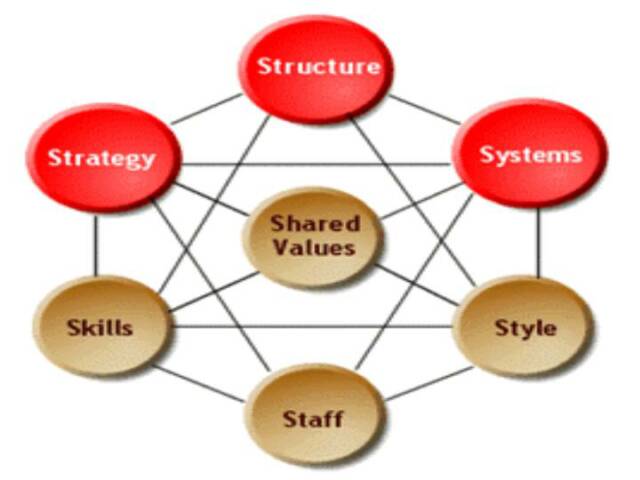
The seven elements are distinguished in so called hard S’s and soft S’s. The hard elements (consisting with Strategy, Structure, and Systems) are feasible and easy to identify. They are easier to change than the others. They can be found in strategy statements, corporate plans, organizational charts and other documentations.
The four soft S’s (consisting of Skills, Staff, Style, and Shared Values) are not as feasible. They are harder to change directly, and typically take longer to do so. They are harder to describe since capabilities, values and elements of corporate culture are continuously developing and changing. They are highly determined by the people at work in the organization. Effective companies, however, tend to pay as much attention to these factors as to the hard S’s.
Essentially, you'll want to run through each of the seven points and analyze how they fit in with your business. The concepts remain fairly similar, with some minor changes:
- Strategy: Refers to the plan or route-map to maintain competitive advantage. What is your plan for the future? How do you intend to achieve the objectives? When was the last time you looked at your business plan? What were the actions you took after looking at it? When was the last time you updated your business plan? How do you deal with competitive pressure? What are the sources of sustainable competitive advantage such as cost, quality, service and technical leadership? What are the key strategic priorities such as improved customer service? How are changes in customer demand dealt with? How do you deliver greater value to customers?
- Structure: Refers to the framework in which the activities of the organization’s members are coordinated. A key function of structure is to focus employees’ attention on what needs to get done by defining the work they do and whom they should be working with. How is the organizational structure designed right now? How is the team divided? How do the various departments coordinate activities? How do the team members organize and align themselves? Is decision making and controlling centralized or decentralized? Is this as it should be, given what you’re doing? Where are the lines of communication? If you had to suddenly hire another 6 employees tomorrow, what would it look like? What changes would you have to make? If your customer has a complaint, or if there is some kind of emergency, how are problems escalated? Is there a stated hierarchy and an "in-practice" hierarchy?
- Systems: Refers to the day-to-day processes and procedures. Having effective systems helps reduce redundancy and streamlines process. How do you gather business intelligence? Do you have a unified database? Does the organization have the systems it needs to run your department such as monitoring for customer satisfaction? If you have to put together a report on something, could you do it quickly? What happens if one of your staff leaves; will they take with them a key part of your business intelligence? What are the main systems that run the organization? Where are the controls and how are they monitored and evaluated? What internal rules and processes does the team use to keep on track?
- Shared Values: (also known as Superordinate goals): Refers to the guiding principles of the organization. These are the core values of the company and your department. What are your core and stated values? What do you measure and reward? Are they the same thing? How can you make minor changes to bring them in line with each other? What are your stated values supposed to contribute to your business? Do they contribute what you want them to contribute? Does your employees have a shared understanding of why the company exists? Do they share the same company and departmental vision? How do they described the ways in which the company is distinctive? Is the focus on quality, emphasis on people, etc?
- Style: Refers to the leadership approach and the organizations overall operating approach. How would you describe your department? How would your employees describe your department? How would your competitors describe your department? How would your customers describe your department? How would your vendors describe your department? If all five would say the same thing then you're on the right track; if they say different things then it could indicate a potential problem. Is this same style and culture going to carry you through the next few years? What will have to change for you to grow? How participative is your management and leadership style? How effective is your leadership? How good are you at making decisions? Where do you focus most of your time and attention? Do your employees tend to be competitive or cooperative? Are there real teams functioning within the organization, or are they just nominal groups?
- Staff: Refers to the staff levels and how people are hired, developed, trained, socialized, integrated, and ultimately how their careers are managed. Are you staffed to serve customers adequately? Will the addition or deletion of one or two staff members change anything? How do you train and mentor employees? Is your training methods effective? Are your staff members trained to do their jobs? Can you give them any other skills or resources to do their job better? What's holding them back from helping you grow your business? Are they "bought in" to seeing your business develop? What positions or specializations are represented within the team? What positions need to be filled? Are there gaps in required competencies?
- Skills: Refers to the distinctive competencies of people within the organization. What skills have you been hiring for? What skills do you need? What skills will you need in 1 or 2 years from now? Does someone in your organization have those skills and are you grooming them for an important role in the next 1 or 2 years? What skills will you need to possess in two years that are different than the skills you possess today? What are the strongest skills represented within the team? Are there any skills gaps? What is the team known for doing well? Do the current employees have the ability to do the job? How are skills monitored and assessed?
An example of the 7-S model in action, for an improvement opportunity, would be if the department was misaligned resulting in poor performance.
We will act on some of the questions just described from the 7-S model in the next section of this lesson, “Manage your Department to its Optimum in 10 steps.”

The 7-S Model and how it can help improve your organization
The 7-S model is a useful way to look at the many interrelated aspects of a complex organization and it's a great way to help you understand your organization and leverage it to maximum efficiency and profitability. It was developed by Tom Peters and Robert Waterman while working at McKinsey & Company.
The basic premise of the model is that there are seven internal aspects of an organization that need to be aligned if it is to be successful. It is the seven key elements of an organization that are critical to understand its effectiveness. These seven elements are: Strategy, Structure, Systems, Shared Values, Style, Staff, and Skills. The beauty of the 7-S model is that it can be used in a wide variety of situations such as:
- A diagnostic tool for an ineffective organization.
- Improve the performance of a company.
- Guides organizational changes.
- Align departments and processes during a merger or acquisition.
- Determine how best to implement a proposed strategy.
- Combines rational and hard elements with emotional and soft elements.
Managers must act on all S’s in parallel as all S’s are interrelated. All elements must align equally:

 | ||||